
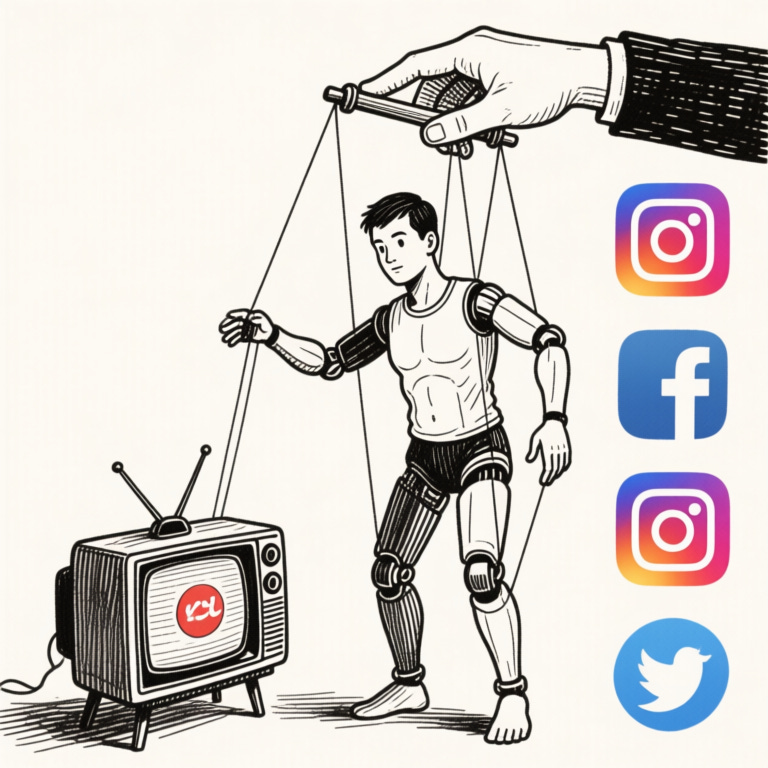
They "thought" they were "Free": Methods of mainstream media and social media narrative control that are being used on the mostly unaware public
or Why you should cut the cord, cancel tv, and delete your social media accounts, so you can start thinking your own thoughts and drawing your own conclusions

Below is a structured and objective taxonomy of methods used by mainstream media and social media platforms to influence, shape, and direct the public’s perceptual narratives — arranged in approximate order of prevalence and systemic impact.
I. Mainstream Media Methods (broadcast, print, digital press)
1. Framing and Selective Emphasis
Presentation of facts within a specific interpretive frame (e.g., economic, moral, or emotional framing).
Highlights certain aspects of a story while omitting or minimizing others to cue specific interpretations.
2. Agenda Setting
Prioritization of which issues are covered most frequently or prominently, creating public perception of what matters most.
Often expressed through headline volume, repetition, and lead story placement.
3. Source Filtering and Gatekeeping
Reliance on pre-approved or institutionally sanctioned sources (government, corporate, academic) while marginalizing dissenting or unofficial voices.
Shapes the range of acceptable discourse (the “Overton window”).
4. Emotional Narrative Construction
Use of pathos, imagery, and human-interest framing to generate emotional alignment with a preferred moral or political stance.
Amplifies fear, outrage, or compassion to drive engagement and identification.
5. Repetition and Linguistic Normalization
Repeated phrasing or terminology (“climate crisis,” “cost-of-living,” “threat to democracy”) establishes conceptual familiarity and automatic belief.
6. Expert Credentialization
Selective presentation of “experts” who reinforce the outlet’s chosen narrative, creating an appearance of empirical consensus.
7. Omission and Silencing
Complete exclusion of inconvenient facts, studies, or historical context that would destabilize the dominant storyline.
8. Moral Polarization
Dichotomizing issues into moral binaries (good vs. bad, civilized vs. barbaric) to discourage nuanced evaluation.
9. Symbolic Association and Visual Cues
Image selection, camera angles, lighting, and sound design to convey subliminal tone (e.g., heroic vs. menacing).
10. Manufactured Consensus
Use of polling, “public opinion” panels, and editorial repetition to simulate broad agreement with the outlet’s stance.
II. Social Media Methods (platform-based ecosystem)
1. Algorithmic Curation
Personalized feed algorithms prioritize emotionally reactive or ideologically aligned content to maximize engagement, indirectly reinforcing confirmation bias.
2. Engagement Optimization
Ranking systems favor content that triggers strong emotion (anger, fear, outrage), amplifying divisive narratives organically.
3. Shadow Prioritization / Demotion
Non-transparent ranking adjustments that quietly suppress certain content or elevate others without explicit censorship.
4. Bot and Sockpuppet Amplification
Automated or coordinated inauthentic accounts simulate consensus, virality, or social proof.
5. Influencer and Micro-Narrative Seeding
Strategic partnerships or sponsorships where influencers disseminate specific talking points under the guise of personal opinion.
6. Information Overload
Flooding the ecosystem with high-volume, low-value data that overwhelms critical discernment (“noise-to-signal manipulation”).
7. Echo-Chamber Formation
Platform design reinforces ideological enclaves through recommendation loops, making divergent perspectives less visible.
8. Trend and Hashtag Engineering
Artificial promotion of topics or slogans to simulate grassroots momentum or shift attention away from competing issues.
9. Psychographic Targeting
Data-driven narrative targeting tailored to users’ personality profiles, optimizing persuasive effect on different psychotypes.
10. Content Moderation Framing
The rules of acceptable speech define what narratives can circulate; enforcement shapes public sense of “truth boundaries.”
Synthesis
Mainstream media primarily controls what to think about and how to interpret it via editorial framing, gatekeeping, and emotional storytelling.
Social media primarily controls what you see and who you interact with via algorithmic curation, behavioral data loops, and attention economics.
a (now) very old take on synthetic Soul harvesting, while quite naive in some of its theory and it was from some years back I still feel its worth the time to listen ...
Indeed when viewed in the lens of Our more tech savvy opinions it actually resonates on how far down the hole We are:
https://www.offplanetradio.com/triunity-series/the-triunity-series-with-dr-shmuel-asher-episode-6-simulacrum-building-the-perfect-beast
In fact when viewed in the context that Humanity cannot even shift off/out of the binary zio vs commie trap laid by the invader it examples how the shiny moving pages doth transfix us all..
I did a trial "sub-stack" total delete the other day, it took half a dozen attempts and still could not confirm total delete.
thus I try not to dive in too deeply now but appreciate the angle you are speaking from
Excellent summary. Thank you.